Showing posts with label Facebook. Show all posts

Banjo App Could Disrupt Twitter as a #Socialbiz and #Custserv Tool

Saturday, October 1, 2011

Image representing Twitter as depicted in Crun...Image via CrunchBasehere is a copy of an email I got from Jennifer Peck, marketing guru at social app Banjo about a week ago. At the time I was writing for ReadWriteWeb and considering different apps that would make good news story material about how mobile apps are one of the big forces behind changes in how consumers shop, consumers talk to each other, and how #custserv (Customer Service) teams operate. 


In this email, Peck showed me how following topics and trends on social monitoring platforms like Hootsuite, Twitter and Tweetdeck can only go so far. I was compelled by her evidence enough to publish it here, to promote a discussion of the Jobs to be Done with social apps in marketing.  


Peck writes: 


Banjo just presented at Ad Age in San Francisco and I learned something about the "official hashtag" of the conference.  People weren't using it.   The official was #aadigital and the hashtags being used were #aadigital, #digitalwest #adage #adagewest or more commonly NO HASH TAG AT ALL. 
So, when you are trying to follow the twitter feed at an event or if you are following from afar, it's likely you will be missing most of the conversation.  Enter Banjo. 
I simply went to the map view, typed in 1290 Avenue of the Americas, NY, and voila.  I was instantly seeing all the activity coming out of SMASH.

Here are some of the screen shots that Peck attached in the email.  They are numbered to give context, and they are listed in chronological order as you scroll down the screen.

Photo 1.  Clearly at SMASH but the # is rackspace and the next is no hash at all
Photo 2.  This shows our NEW group mapping feature coming out with our next release (submitted to the Apple store yesterday)
Photo 3.  Again no hash tags - photo included
Photo 4.  No hash and #smashsummit
Photo 5.  No hash and #smashsummit - photo included
Photo 6.  The first #smashNYC
Photo 7.  No hash - photos included of @davemcclure
Photo 8.  See the top - NEW FEATURE of follow on twitter and favorite button
Photo 9.  Now following on twitter - NEW FEATURE 


Peck says that Banjo will be releasing new features soon, which will include map grouping, and being able to follow someone on Twitter. 
Enhanced by Zemanta

Be a Hedgehog: Marketing as Human Variety Disguised as One Simple Trick

Thursday, September 29, 2011

London Underground roundel logoImage via WikipediaScene: London Underground, 1996.  It's winter. A little boy is wrapped up in a plaid wool jacket. His mother holds his hand. She's wearing a violet sweater and a green anorak. Her blondish hair is tied back very loosely in a hair band, and tendrils of her hair spill down her left cheek, which is flushed with the London wind.

On the wall is plastered a giant poster for Sonic the Hedgehog, a Sega Genesis (remember that?) game. It was advertising Sega World, which used to be a little video game playground for kids and adults in Hammersmith. It looked something like this:


As a train heads into the station, the stationmaster's automated voice announces the arrival, and the little boy asks his mother, "why is that hedgehog so clever?"

The mother looks down and says, "Because he can go where he wants, when he wants."

While it seems a proper assessment of the Sonic brand, I think it's also a very accurate characterization of what a branding manager or a community manager should be. Facebook, and other social marketing platforms, should be your video game. You are the hero in your video game and your mission is to be clever.

I don't mean clever in the sense of tricking people to like your product. I mean clever, like a journalist is clever, or a sleuth. You need to go about your day finding things for people, and bringing them knowledge.  You need to be like that cool kid in high school who always had some factual information for you, who always told you something a little bit different, who was gifted in a way that made him seem a little bit out of the ordinary, but very real.


Be yourself. Bring life to people, through the life you live.

If you are like this to people, they will like you. And liking you is the very reason they will like the brand you represent. Because people don't really love brands. They love people.

People matter more than brands, and that's what a lot of branding people don't want you to know, because their whole life has been about selling the brand.

That's changing, especially with platforms like Facebook's Timeline.


Enhanced by Zemanta

#Infographic: Facebook and Twitter Stepping on Student's First Amendment Rights?

Tuesday, September 27, 2011

Here's a good one. Are Facebook and Twitter infringing upon First Amendment rights in the classroom? In effect, are they putting the smack down on your student's fundamental pursuit of liberty? Apparently not, according to the Knight Foundation.

Even though teachers cringe at the idea of using social media in the classroom, it appears that using social media (or at least learning since the advent of social media) has pushed students to a more fundamental appreciation for freedom of speech.

Check out this infographic:

#Facebook Privacy Issues You Should Learn, Even if it Doesn't Alarm You

Monday, September 26, 2011

FACEBOOK FEATURED FRiENDS o^^oImage by aJ GAZMEN ツ GucciBeaR via FlickrIt is not clear to me whether this issue is what it is being made out to be, but Nik Cubrilovic has taken the time over the past two years to examine the way Facebook places cookies in your browser and your laptop. He's taken enough care that I thought it would be worth posting here the central tenet of his message.

Logging out of Facebook is not enough, the social networking site has privacy issues.

Facebook may be tracking much more than we think they are tracking, for more reasons than we care to imagine. After all, they have a job to do -- get the world to share its information.

If Google is the repository for the world's information, then Facebook is the international airport terminal for all the shipments of data we call our social context. 
Enhanced by Zemanta

Social Platforms Could Make You Feel Insecure: Fred Wilson, Union Square Ventures

Friday, September 23, 2011

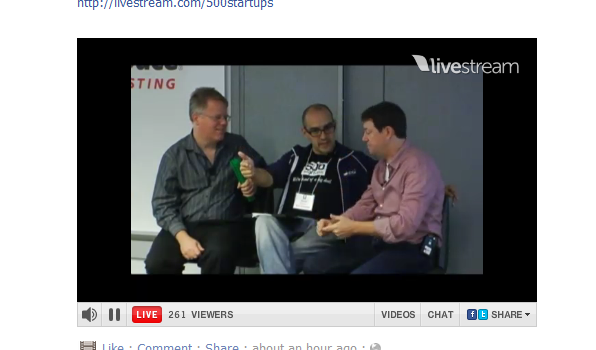
Individuals and brand identities should not be hosted on a single platform, because platforms like Twitter and Facebook have to watch out for their own business, says Fred Wilson, a managing partner at VC firm Union Square Ventures in New York.


In an intense debate with Silicon Valley tech guru Robert Scoble at the New York City Smash Summit, Wilson told a room of social media marketers that it is a "horrible idea" for people to build their presence on platforms alone without any web real estate of their own.

While saying that he had recently become more impressed with Facebook and their new suggestions for lists, Wilson said he still thinks that it's a bad idea for brands especially to advocate for their identity on platforms. They should build their own freehold on the web.

"Companies that get stuck on one platform, when the platform changes the rules, you get f-----," said Wilson.

Wilson ended by saying that platforms like Facebook are not trying to destroy people with their new iterations, like Timeline, released yesterday. "Most of the time, the people who run product and run the companies are doing they are trying to do the best thing for their product," says Wilson.

But it was still not a good idea for consumers or individuals to rely on platforms as the sole real estate for their identity. "You are advocating your experience of the world with some relationship with a company, never do that, that's a horrible idea!" he said.

Robert Scoble suggested that Google+ was a platform for people's identity. Holding up a handful of green straws, he said that he had rolled up in one of them a $20 bill.

"That's Twitter. You can barely see the signal." he said. He then wrote on a straw and used the same handful of straws to say that labeled experience on the web makes it so much easier to find the money. That was Google+, he said.

What Would Make Facebook Lose Relevancy in the Fight Against #Google+

Sunday, September 18, 2011

Facebook changed the way its navigation bar operates yesterday, in a capitulation to Google+ and Twitter. it's a sign that Facebook's biggest issue now is relevancy and sorting out signal from noise for its 700 million plus user base.

We saw the Google+ mimicry with the release of the subscribe button and smart lists this week. The scrolling nav bar will keep people updated about their updates and reduce the likelihood they will travel to other sites outside of Facebook.

It should also help people manage the new barrage of information from all the new subscribers as friends, and friends of friends start searching out and connecting to people for new social information.

Barry Schuler, former chairman and CEO of AOL, told me on Twitter today that "Facebook has to deal with Twitter from below and Google+ from above. Their biggest strength, friend-friend, becoming a weakness."

This is exactly right. Some suspect that Facebook will reveal at f8 next week a scrolling news feed, a version of which they rolled out in a test earlier this summer.

The new barrage of increased network information makes relevancy an incredibly important issue for anyone with a Facebook profile, and it has now become Facebook's central issue.

With new subscriptions and subscribers going public, updates will begin to come to these users' feeds at a faster rate. As people have subscribed to my feeds, I have noticed that I am barraged with more and more signals. This has made Facebook management an almost all-day affair.

I feel like I am dealing with the news ticker on the bottom of a cable tv news channel.
This is the problem of news feed relevance, which we have written about before.

Facebook Finally Influencing How We Experience News, Relationships, and Education?

Image representing Mark Zuckerberg as depicted...Image via CrunchBase
We all agree that something fundamental has changed in the way Facebook operates as an information system and in the way it views our human relationships.  I don't think that it's just a race to compete with Twitter or Google+ for world domination in the social graph.

Would someone like Mark Zuckerberg be concerned with something as petty as business competition? No, there is a much longer game being played here, and it goes to the core of how we experience reality and use that experience to succeed, thrive and exist in the world.

Facebook smart lists and the subscribe button changes our real world experience in three core ways: 1. How we stay informed of world and local events; 2. How we experience the education system; 3. How we search and discover information and people.

The fundamental changes in design and user control could alter our fundamental understanding of what is public and what is private.

How Facebook can Personalize Events and Eliminate Your Need for the Nightly News at 10

The most recent change in Facebook eliminates the daisy chain, or telegraphing, of information from one single news event down the line to the millions of people who digest it and process it as news. But on a much deeper level, it gives us a platform of data on which we can, to a granular degree, determine what is similar about one human's experience as it relates to our experience.

In a sense, we have the facts. News of old was about really really good storytelling, and about a general anesthesia called the human experience that meant we had to trust, explicitly, that every human being's experience was just like ours.  News banks on this as its currency.

Not more than 45 years ago, American audiences had three main channels to get their nightly news. News was about a brand experience.  Our ancestors trusted Walter Cronkite to tell us about the Vietnam War's pitch battles, as it pitted Democracy against Communism, for example. Our forefathers, at the advent of public broadcast television believed in Cronkite and other news anchors as people who could speak cogently and effortlessly to millions of people about singular events that happened 8,000 miles away, experienced by someone we have never met before.

Not only did we have this general anesthetic trust in the humanity of the person who experienced that horrible event, we believed that his experience was also like ours, at a deeply human level. We empathized.  If you think about it, how weird is that? Did we really know Lance Corporal Bill Jones? No. But we knew his human experience, and when he died in that firefright in Da Nang, we believed.

With subscription lists, we see a Facebook that is a hybrid of something like Google+ and something like Twitter, and that hypermash is something like a hyperlocal, personalized news feed that mixes the personal with the objective.  We, or people like us, are now connected to Lance Corporal Bill Stevens, in Afghanistan. And you know what? War does not look like the black and white news reels sent by satellite to the news desk to be seen by 10pm.

It looks more like X Boxes and foot patrols, bad C-rations and complaints about the
Giants winning the World Series. Now that Facebook has opened up the firehose, so to speak, we can search and find many of these people - a Bob Woodward of the Washington Post and a Private Johnny X from Delaware who is serving in the war.
The creation of subscription lists is the first move towards socializing news in a way that should broaden our sense of what is the human experience. Instead of depending on the nightly anesthesia at 10, we will see for ourselves what people see, think and feel. Since Facebook has the social profile game down pat, when you get your news now, the chances are very high that you are also going to get the private context around that news.

Which should also force changes in the way we learn.

How Facebook Turns Education Into an Experience Rather than a System

Education in the future - heck, it's even happening now - will move from a system of trusting what teacher says, because the teacher gives us the state-mandated tests, to being tested, in a real world sense by the viewpoints and actions of real world people.

Call it socialized education with a real world system for credentials. With so many people, experts even, available to users of the social network, education can fundamentally change from the really old school system of reading textbooks, being tested for recall and proficiency, and inter-classroom competition for grades to something where there is a real world problem, and a crowd of knowledgeable and caring individuals who can rally to the cause and fix it.

Our children could begin to learn through relationships, something reserved, right now, for experiences inside the classroom and the school. We send kids to school in order that they learn how to go to school. We know enough about congnition and learning now to know that systems are really good at running as systems, but they can't be made to teach people to think outside the system. That would ruin the purpose of a system.

Systems sustain themselves.

Imagine a Facebook Education. You have access to millions of realtime experts all over the globe, speaking hundreds of different languages, expressing thought, problems and solutions in multiple angles. That in and of itself is a learning experience.

With carefully edited and monitored barriers of interaction, what teacher would not wish his students to thrive in a real world interaction with the creators of the Three Gorges Dam in China, for example, while backing up those engineering lessons with lessons in Chinese, Physics, culture and other lesson areas through conversations with people who do that work every day?

Which brings us to the final change:

Facebook Is Priming Itself for the Next Great Change in Search, Social Discovery

Someone, everywhere, knows something. How do you find these people?

Smart Lists and Subscriber buttons take us a little bit closer.

I don't know jack about Brooklyn. I live in a small hamlet called Manhattan, surrounded by water. The last time I was in Brooklyn, I was dating someone who lived there. I don't have much reason to go back, if you know what I'm saying. How do I find a really great restaurant, then, if I should even think about getting on the L train and crossing into the world's first city? I ask my friend, N. She lives in Brooklyn.

There is the rub. My relationships fundamentally determine where I go and what I do. I could use an app on my phone to recommend something to me. And do you know what helps that algorithm make those recommendations? My social network has access to so much more information than I do, and suddenly brand names and big Michelin rankings don't mean anything anymore

In this way, you can argue that Facebook is competing with Google for the search portion of social graph. But they have the toehold. They already have nearly 800 million "friends." That's 799 million potential relationships that I could have, in some form or another.

That's a lot of great Thai restaurants in Bangkok, for example, some of which do not have Zagat ratings.


Enhanced by Zemanta

Daily Deals Down the Drain, Facebook Virtual Currency Coming?

Monday, September 5, 2011

Image representing Facebook as depicted in Cru...Image via CrunchBaseFacebook decided that they would leave the daily deals business.


Here is what I left in the comments section of the article I just linked to:

This is a really interesting article but I don't understand why it doesn't mention that the difficulty with branding is a likely driver in this kind of move. Daily deals need to differentiate themselves from each other in the market, and that is not a Facebook strength. It seems to me that Facebook plays a rather neutral position when it comes to creative work. they may have realized that it was resource intensive to pursue...

With all due respect to Dan Mitchell, who contributed this article at Fortune, I feel like he points out the problem without really addressing it. The fundamental problem for Facebook is that it costs a lot of money to make a branding exercise out of fine-tuning the daily deals offering in the marketplace. According to Jim Moran, co-founder of Yipit, there are currently 521 daily deal sites out there.

Mitchell doesn't close the loop. Facebook would not want to spend money, people, time or collateral on making themselves different. That's not what they do. Facebook does Facebook things. Anyway, Mitchell says:
There will likely always be a market for online coupons. But the ease of market entry and the fact that most deal services aren't differentiated from each other makes for a toxic combination for companies like Groupon and LivingSocial hoping to dominate the market. Customers have no compelling reason to stick with, for example, Groupon; they can easily go to Living Social or any other such service without losing anything. 
What if Facebook instead focused on creating their own virtual currency?  As Mitchell says, there will be a market for online coupons. But Facebook likes to keep things in the Facebook perimeter. as long as you would be able to buy Facebook things with Facebook money, then everything would be alright.


Enhanced by Zemanta

Getting Clout Out of Klout: In Which Our Author Asks Why Should We Care?

Sunday, September 4, 2011

We've been mesmerized by Klout ever since all of us started using it at Re-Wired. Each of us has a Klout account, and each of us -- obviously -- has a different Klout score.

What I would like to argue here is that there are two strategies or ways in which people pursue Klout -- and these are, perhaps competing strategies.

We know that Klout is a rather vague assemblage of signals that create influence: Time on a social media networks + active engagement with differing levels of engaged and influential people on networks + messaging (actively clicked on links) + traffic numbers and much more.

But there are also incentives that get us to increase behavior in order to achieve this Klout. What I'd like to know is whether Klout disrupts not only the marketing and advertising model in the traditional sense, but if it is also disrupting the traditional -- though much newer -- social media conversation model.

Klout? Who Dat? 


The folks at Re-Wired do different things with media at different times. I think it's obvious looking at our scores. We can tell you that we understand that our behavior online is different so it makes sense that our Klout is different. Look at our profiles, and you can see we are involved in much smaller or greater numbers of networks relative to each other. 

Brian Tolle's Klout Score and Profile


Bob Moesta's Klout Score and Profile


Chris Spiek's Klout Score and Profile


Douglas Crets's Klout Score and Profile


How is Klout Measured? Should I Care?

With so many social platforms out there, and so many socially-engaged audiences out there consuming everyone's media, having an understanding of how influential one is means something these days. What it means is not exactly clear, since there are competing non-standardized standards.

The tendency is to look to Klout as the social media credit agency. It should be able to objectively tell us what makes someone have a lot of Klout. However, it's unclear.

Is it:

1. Working on a big media platform?

2. The conversation one has with other social media savvy people, in blog posts, tweets, Facebook posts, or images on Instagram?

3. Is Twitter more influential than Facebook?

4. Is it a signal vs. noise thing?

There is no clear determination and the Klout website does not tell us much. In a soon to be published interview, I ask Klout's CEO about this. I will link to it here, once I publish it later this weekend.

What Makes Me Want Klout? 

Now we're getting to the nitty-gritty. We really don't know the answer. It used to be our peers. But if the users of Klout are to be believed, now it's Perks.

Our Klout consumption is being driven by our need to be recognized by brands, which makes it different than our typical desire to be known within the social media ecosystem of our peers.  My behavior online -- if I am susceptible to such suggestion and intrigue -- will make me more open to being communicative and associating with people I don't know. I will be looking for people who have the same interests, and whether I know them or not, I will engage with them in order to "influence" them or be influenced by them.

This is the system of social currency in action.

So what kind of person do I have to be to influence, and to be the target of people who wish to be influenced by me?

Here are hints. Here is a list of the top ten most influential tech bloggers on Klout.
Enhanced by Zemanta